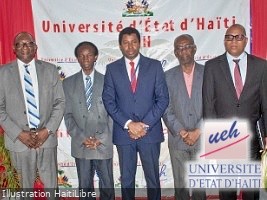
In a landmark advancement for Haitian higher education, the State University of Haiti (UEH) inaugurated its pioneering Master’s program in Public Policy Analysis with specialization in Economics and Finance (MAPPEF) on January 23, 2026. This strategically developed graduate program emerges as an institutional response to Haiti’s pressing governance challenges and represents a concerted effort to bolster national economic management capabilities.
Developed through intensive collaboration between UEH’s Faculty of Law and Economic Sciences (FDSE) and Haiti’s Ministry of Economy and Finance (MEF), the two-year curriculum comprises four semesters of rigorous study. The program’s core mission centers on cultivating expertise in designing, implementing, and evaluating socio-economic public policies—addressing what university leadership identifies as a critical barrier to national development.
UEH Rector Dieuseul Prédélus emphasized the program’s significance beyond conventional academic boundaries, characterizing it as a direct intervention in Haiti’s development emergency. ‘The absence of coherent and properly assessed public policies constitutes a fundamental impediment to Haiti’s progress,’ Prédélus stated, underscoring the program’s practical orientation.
Amid multidimensional national crises, MAPPEF aims to produce highly skilled professionals capable of converting political objectives into tangible outcomes that promote inclusive economic growth and poverty reduction. Faculty Dean Jean Eugène Pierre-Louis highlighted the program’s role in countering brain drain by creating a talent reservoir for Haitian public administration.
Program graduates will be positioned for strategic roles within key governmental institutions including the Prime Minister’s Office, Ministry of Economy and Finance, Ministry of Planning and External Cooperation, and the Bank of the Republic of Haiti, alongside opportunities in international organizations and consulting firms.
Academic coordinator Professor Luc Dieubénite Alexis detailed the program’s structure: 60 credits distributed across 14 specialized modules, complemented by two professional internships and a culminating thesis. The hybrid delivery format combines in-person and online instruction, employing innovative pedagogical approaches including flipped classrooms, case studies, and adult learning methodologies.
The initiative extends beyond national borders through prospective partnerships with the University of the French West Indies and the CEDIMES international research network, ensuring both global recognition and maintained academic excellence.