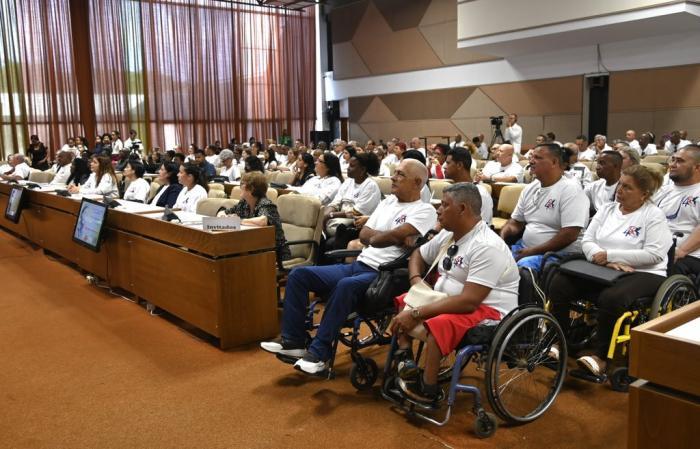
In a landmark demonstration of governmental commitment to social inclusion, Cuban President Miguel Díaz-Canel inaugurated the inaugural Meeting of Organizations of Persons with Disabilities on Monday. The gathering, convened at Havana’s Convention Center, represents an unprecedented convergence of disability advocacy groups within the Communist nation.
Addressing delegates, President Díaz-Canel, who also serves as First Secretary of the Communist Party’s Central Committee, articulated the government’s unwavering support for disability rights. “Your presence here reaffirms your essential role in our socialist construction,” he declared, emphasizing that persons with disabilities constitute a vital component of Cuba’s societal fabric.
The forum, strategically timed to precede December 3rd’s International Day of Persons with Disabilities, occurs alongside the 15th National Conference on Equal Opportunities organized by the Cuban Association of People with Physical Disabilities (ACLIFIM). This parallel scheduling underscores Cuba’s integrated approach to disability advocacy despite confronting severe economic challenges exacerbated by international sanctions.
President Díaz-Canel framed the current efforts within historical context, noting that contemporary initiatives build upon foundations established by revolutionary leader Fidel Castro. “We maintain our commitment to constructing an inclusive society despite the intensified economic blockade that has created significant difficulties across multiple sectors,” he asserted.
The President characterized the meeting as an exercise in critical unity, describing how diverse organizations are collaborating to “build consensus on advancing disability rights amidst current challenges.” He explicitly welcomed constructive criticism as “a source for improving governmental work” and ensuring no citizen remains excluded from societal participation.
Mabel Ballesteros López, National President of ACLIFIM, highlighted the historical significance of this consolidated gathering. She contrasted Cuba’s proactive stance with what she characterized as “passive governments worldwide” facing growing exclusion gaps. Ballesteros López explicitly connected contemporary disability policies to revolutionary legacy, noting how associative movements “have grown with the Revolution’s social policy, backed by Fidel’s vision for a just and equitable society.”