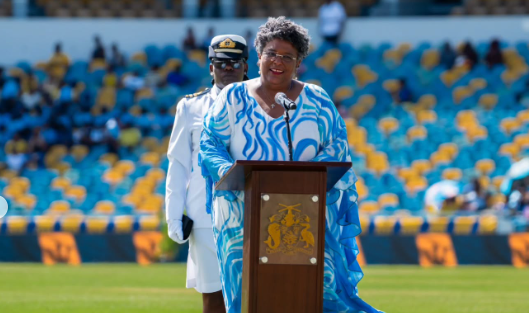
In a powerful address during Barbados’ Independence and Republic Day ceremonies, Prime Minister Mia Mottley issued a compelling appeal for national unity in combating criminality, emphasizing that law enforcement alone cannot guarantee public safety. Speaking at the installation ceremony of President Lt Col the Most Hon Jeffrey Bostic at Kensington Oval, Mottley framed crime prevention as a collective obligation requiring fundamental changes in community attitudes and behaviors.
The Prime Minister’s urgent call follows a series of violent incidents that have unsettled the island nation, including Saturday’s fatal altercation claiming a 30-year-old St Philip resident and separate shooting injuries involving two juveniles. Mottley articulated that while police and judicial systems remain crucial, sustainable security demands deeper societal transformation.
‘Reclaiming our communities stands at the very core of addressing crime beyond mere law enforcement,’ Mottley asserted. ‘Building a safe and prosperous Barbados necessitates conscious decisions within households and neighborhoods alongside institutional efforts.’
The Prime Minister specifically cautioned against three detrimental practices: sheltering criminals, romanticizing violence through symbols or cultural expressions, and neglecting disengaged youth. Instead, she advocated for active intervention and opportunity creation for young people at risk.
Newly installed President Bostic reinforced this message through the launch of the Chapman Challenge, a national mentorship initiative drawing from his personal Bridgetown upbringing. This program urges adults to guide youth, particularly in opportunity-scarce communities, while challenging young Barbadians to transcend their circumstances.
‘This endeavor represents more than a formal program—it constitutes a national mobilization appeal,’ President Bostic declared. ‘We must ensure every child receives adequate guidance to evolve into exemplary citizens.’
Both leaders emphasized mentorship, community engagement, and positive role modeling as transformative mechanisms for social improvement. President Bostic concluded with diplomatic assurances that Barbados would maintain its principled international stance as ‘friends of all, satellites of none,’ while urging citizens to advance with ‘dignity, discipline, and quiet resolve.’